

Denpasar, September 8, 2026 — The Faculty of Agriculture at Udayana University held a Focus Group Discussion (FGD) titled “Adaptation and Development of Bali’s Native Orchid Genetic Resources,” centered on the theme “Orchids for Conservation and Welfare: Synergy Between Universities, Communities, and Sustainable Industry.” The event took place at the Postgraduate Hall, Sudirman Campus, Denpasar, on Tuesday (September 8, 2026). This activity represents a strategic step toward strengthening conservation efforts for Bali’s native orchids through collaboration among academia, government, conservation agencies, local communities, and the industrial sector.
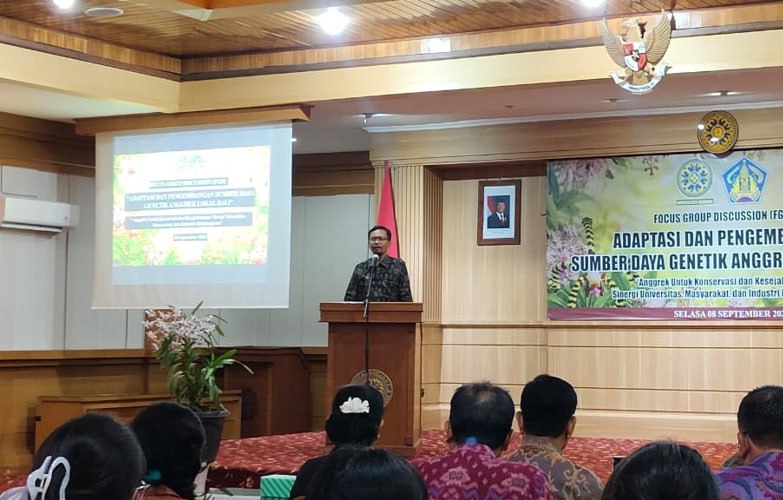
Attendees included the Dean of the Faculty of Agriculture at Udayana University, I Putu Sudiarta, S.P., M.Si., Ph.D.; the Head of the Bali Provincial Agriculture and Food Security Agency, Dr. I Wayan Sunada, S.P., M.Agb.; the Chairperson of the Bali Chapter of the Indonesian Orchid Society (PAI), Mrs. Putri Suastini Koster; as well as the Heads of the Bali Tourism Agency, Bali Economic Affairs Agency, and Bali Regional Research and Innovation Agency (BRIDA); the Head of the Institute for Research and Community Service (LP2M); the Head of the Bali Regional Development Planning Agency; the Head of the Bali Environment and Forestry Agency; and representatives from the Bali Natural Resources Conservation Center (BKSDA), the National Research and Innovation Agency (BRIN), Pancasari Village, and various other stakeholders.
Udayana University’s Faculty of Agriculture Dean, I Putu Sudiarta, S.P., M.Si., Ph.D., stated that the development of genetic resources for Bali’s native orchids is part of the Faculty’s commitment to preserving Bali’s rich biodiversity through an approach combining research, conservation, and community empowerment. The program focuses not only on orchid preservation but also aims to generate tangible benefits for the community through innovation and sustainable economic development.
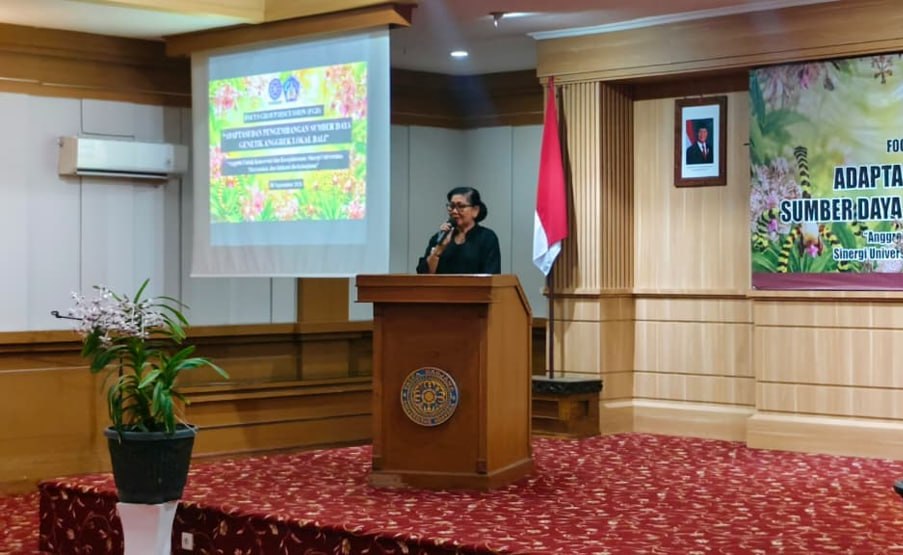
Meanwhile, the Chairperson of the Bali Chapter of the Indonesian Orchid Society (PAI), Mrs. Putri Suastini Koster lent her support to efforts aimed at preserving Bali’s native orchids and officially opened the Focus Group Discussion (FGD). Collaboration among various stakeholders is key to ensuring that Balinese orchids continue to be safeguarded as part of the island’s natural and cultural identity.
During the main FGD session, I Putu Sudiarta, S.P., M.Sc., Ph.D.—Coordinator of the Implementation Team for the Program on the Adaptation and Development of Bali’s Native Orchid Genetic Resources—outlined the program’s development plan. This plan encompasses the exploration, characterization, and conservation of Bali’s wild orchids; the development of orchid propagation technologies; and the establishment of an Orchid Tourism Village in Dasong Hamlet, Pancasari Village, Sukasada District, Buleleng Regency.
The program is structured in continuous phases spanning from 2026 to 2030. The initial phase focuses on orchid exploration, the compilation of databases and distribution maps, the strengthening of community institutions, conservation rooted in local wisdom, the development of *in vitro* culture techniques, and the preparation of conservation-based tourism packages.
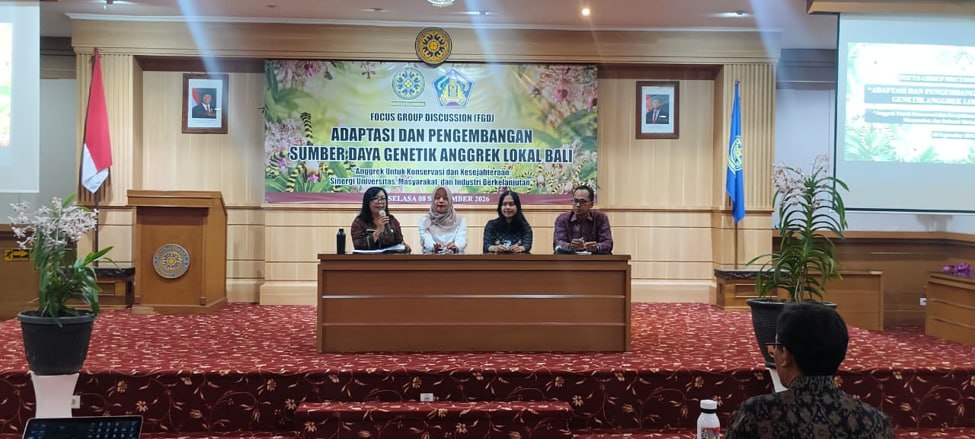
In a presentation by Aninda Retno Utami Wibowo, M.Sc., from BRIN’s Research Center for Biosystematics and Evolution, it was noted that Bali possesses a potential of approximately 230 orchid species that require further documentation and taxonomic study. Exploration, identification, habitat documentation, and location recording are crucial steps in supporting the conservation of Bali’s native orchids.
BRIN also emphasized the importance of scientific documentation—including the recording of plant characteristics, GPS-based locations, and habitat photographs, as well as the compilation of specimen data—to ensure that information regarding Bali’s orchid diversity is systematically preserved.
The conservation program for Bali’s native orchids integrates a scientific approach with Balinese cultural values through the *Tri Hita Karana* philosophy, which advocates for maintaining a harmonious balance between humans, nature, and the Divine. One local approach discussed was the use of the *saput* (or *poleng* cloth—a traditional checkered fabric) as a symbol of balance to support the protection of orchid habitats.
In addition to in-situ conservation, the Faculty of Agriculture at Udayana University is developing orchid propagation technologies—including tissue culture, selfing, crossing, and somatic embryogenesis—to help rescue rare orchid species and provide plant material for sustainable cultivation.
Representatives from the Bali Natural Resources Conservation Center (BKSDA Bali) emphasized the importance of responsibly managing the genetic resources of wild species in accordance with conservation regulations. Access to genetic resources for research purposes must involve proper registration, permitting, and documentation processes.

BKSDA Bali also supports efforts to inventory and explore vegetation diversity within conservation areas—such as the Lake Buyan–Lake Tamblingan Nature Recreation Park—as part of initiatives to advance conservation and biodiversity-based tourism.
During the tourism development session, Dr. I Putu Sudana, A.Par., M.Par., presented a concept for a community-based “Orchid Tourism Village” as a way to translate conservation and environmental education into tangible outcomes. The village’s development aims to make orchids the primary attraction, offering a tourism experience centered on the concepts of “Something to See, Something to Do, Something to Buy, Something to Learn, and Something to Share.”
This concept positions the community as the central actor, involving village government, Village-Owned Enterprises (BUMDes), tourism awareness groups, farmer groups, orchid grower groups, MSMEs, and the younger generation in building a conservation-based tourism ecosystem.
Through this Focus Group Discussion (FGD), participants agreed that preserving Bali’s native orchids requires long-term commitment and collaboration. Key recommendations included the need to inventory approximately 250 orchid species, strengthen local culture-based conservation, develop research-based propagation methods, and create downstream products that benefit the community of Dasong Hamlet.
The Faculty of Agriculture at Udayana University is committed to establishing the local Balinese orchid genetic resource development program as a collaborative model integrating conservation, research, education, tourism, and community empowerment.