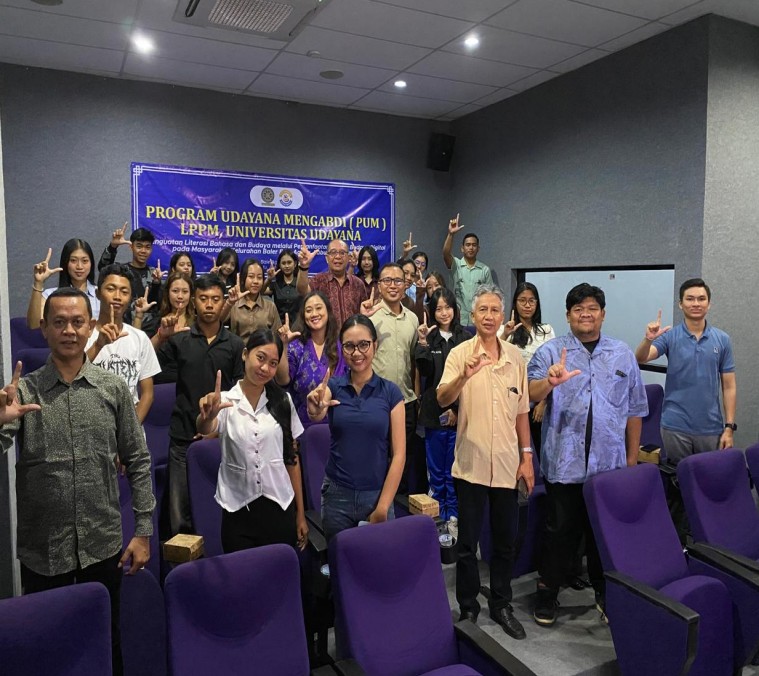
Jembrana, August 8, 2026 – The Faculty of Cultural Sciences at Udayana University demonstrated its commitment to the “Tri Dharma” (Three Pillars of Higher Education) through a Community Service (PKM) activity titled “Strengthening Language and Cultural Literacy through the Utilization of Digital Cultural Products in the Baler Bale Agung Urban Village Community, Jembrana Regency.” The event was held on Saturday (August 8, 2026) at the Weaving Center (Centra Tenun) in Baler Bale Agung, Jembrana Regency.
Led by Prof. Dr. I Made Netra, S.S., M.Hum., the activity was attended by approximately 30 participants from the local youth organization (*Yowana* or *Sekehe Teruna*) of Baler Bale Agung, coordinated by Gede Prawira Bhujangga W. In addition to the team of lecturers and students from the Faculty of Cultural Sciences at Udayana University, the event was attended by the Head of Baler Bale Agung Urban Village, Ida Bagus Gede Ananda Kusuma, S.IP., M.AP.; the Chairman of the Jembrana Regency Chapter of Apindo (Indonesian Employers Association), I Gede Agus Sanjaya, S.E., S.H., M.M., CME; local administrative officials; and community leaders.
This activity holds strategic significance as Baler Bale Agung is a designated partner village of the Faculty of Cultural Sciences at Udayana University. Through this partnership status, various education, research, and community service programs are continuously developed to foster collaboration between the university and the community in supporting the preservation of Balinese language, literature, and culture.
The PKM Team Leader, Prof. Dr. I Made Netra, S.S., M.Hum., explained that advancements in information technology should be leveraged as a medium to strengthen national cultural identity. According to him, digital transformation offers immense opportunities to document the richness of local culture, ensuring it can be passed down to future generations. “Preserving language and culture cannot rely solely on oral transmission; it also requires support through high-quality digital documentation and publication. The younger generation plays a vital role as creators of cultural content capable of showcasing regional identity to both national and international audiences,” stated Prof. Netra.
In his remarks, the Head of Baler Bale Agung Village, Ida Bagus Gede Ananda Kusuma, S.IP., M.AP., expressed his appreciation for the Faculty of Cultural Sciences at Udayana University’s consistent support of the Baler Bale Agung community through various academic and community empowerment activities.
“We extend our gratitude to the Faculty of Cultural Sciences at Udayana University for continuing to support Baler Bale Agung as a partner village. Programs like this provide tangible benefits to the community—especially the youth—enabling them to leverage digital technology to preserve and showcase our rich local culture to a wider audience,” he said.
The series of activities began with a presentation on strengthening language literacy by Dr. Ni Ketut Rahayuni, S.S., M.Hum. In her talk, Rahayuni explained that language literacy goes beyond reading and writing skills; it encompasses the ability to understand, use, and preserve language as an integral part of a community’s cultural identity. She noted that regional languages are a cultural heritage that must be nurtured to ensure their survival amidst technological advancements and globalization.
Next, a session on strengthening cultural literacy was delivered by Dr. Drs. I Wayan Suardiana, M.Hum. Suardiana emphasized that cultural literacy involves understanding values, traditions, customs, arts, and local wisdom as components of the national character. He highlighted the use of digital media as an effective strategy for introducing local culture to the younger generation without compromising its authentic values.
In addition to the presentations, participants were introduced to various forms of digital cultural products, techniques for finding credible sources of cultural information, digital ethics, copyright protection for cultural works, and strategies for promoting culture across digital media platforms.
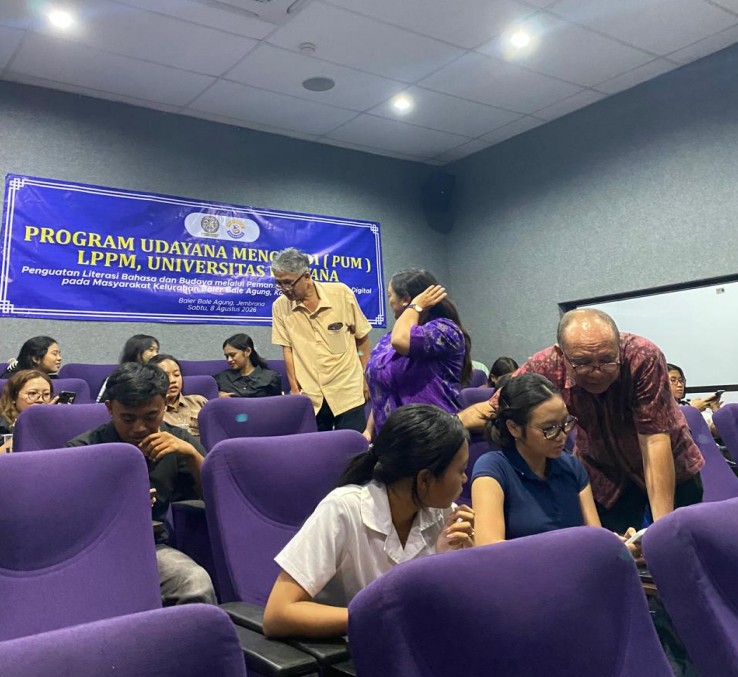
The event continued with a workshop session that gave participants the opportunity to practice creating digital cultural content firsthand. Guided by a team of lecturers and students, participants learned to develop concepts for short videos, digital posters, social media content, and podcast outlines. These projects showcased the cultural potential of Baler Bale Agung Urban Village, including community traditions, weaving crafts, regional language, and other forms of local wisdom.
The training was highly interactive. Participants actively discussed how to package cultural information to appeal to the younger generation while maintaining the accuracy of the content. Hands-on guidance helped participants understand the digital content production process, covering everything from conceptualization and scriptwriting to filming and social media publication techniques.
The presence of the Chairperson of the Jembrana Regency DPK Apindo (Indonesian Employers Association) further strengthened the synergy between the village administration, the university, and the business community in safeguarding the sustainability of local culture. This collaboration aims to foster digital-based innovations in cultural preservation that remain grounded in the customary values and traditions of the Balinese people.
Through this initiative, participants are expected to gain a better understanding of the importance of language and cultural literacy, while also acquiring fundamental skills in using digital technology for the documentation, education, and promotion of local culture. The project’s outcomes include enhanced participant knowledge and skills, the creation of digital cultural product prototypes, activity documentation, media and social media coverage, the drafting of scholarly articles on community service, and strengthened cooperation between the Faculty of Cultural Sciences at Udayana University and the Baler Bale Agung Urban Village administration.
As a partner village of the Faculty of Cultural Sciences at Udayana University, Baler Bale Agung is expected to continue serving as a hub for community empowerment programs rooted in language, literature, culture, and digital technology. The synergy established among the university, the urban village administration, the customary village (*desa adat*), and the local community serves as a vital asset in preserving local cultural identity while building a community that adapts to modern times without losing its essential character.