
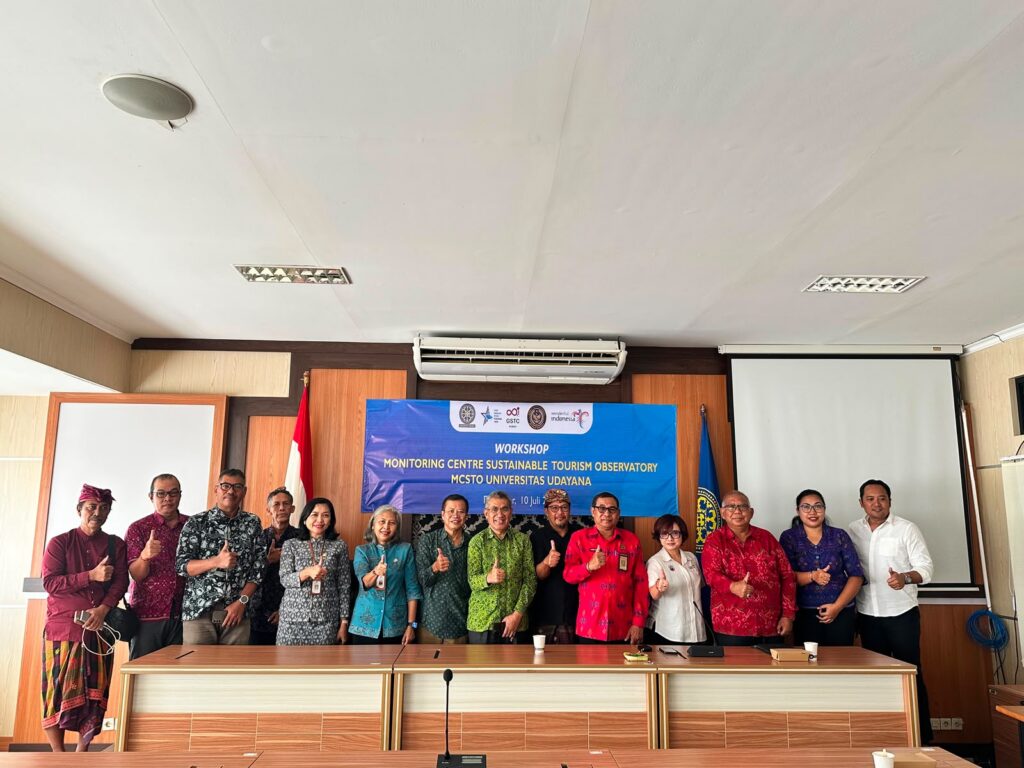
Denpasar – The commitment to strengthening sustainable tourism governance in Indonesia was reaffirmed through the Monitoring Center Sustainable Tourism Observatory (MCSTO) Workshop held by Udayana University on Friday (July 10, 2026). This event served as a crucial opportunity to evaluate the MCSTO’s nearly decade-long journey and to formulate a new direction for the development of the Sanur Tourism Destination as a laboratory for implementing sustainable tourism based on data, collaboration, and local wisdom.
The workshop brought together various stakeholders, including the Ministry of Tourism, Udayana University, the Denpasar City Government, the Village and Traditional Village Governments in the Sanur area, the Tourism Industry Association, as well as academics and practitioners. All parties agreed that the success of tourism development is no longer solely measured by the number of tourist visits, but rather by the destination’s ability to maintain a balance between economic growth, environmental sustainability, and the well-being of local communities.
The MCSTO Coordinator at Udayana University, Prof. Anak Agung Suryawan Wiranatha emphasized that the tourism observatory has a strategic function as a center for monitoring, evaluation, and providing evidence-based policy recommendations. He stated that the various challenges faced over the past few years, both in terms of coordination and program implementation, have actually provided an opportunity to strengthen the synergy of all stakeholders.
“MCSTO is not just an academic forum, but an instrument to ensure that tourism development adheres to sustainable principles. Therefore, stronger collaboration is needed so that each program can be implemented measurably and provide tangible benefits to the community,” he said.
He continued, reaffirming Sanur as the primary observation area for the Udayana University MCSTO. The selection of Sanur is considered highly relevant because this area possesses the characteristics of a mature destination that has developed over decades, yet still maintains its local cultural identity and the involvement of indigenous communities in its management.
Scientifically, the observatory’s presence in Sanur allows for continuous data collection on various tourism development indicators, such as tourist satisfaction, community perception, distribution of economic benefits, environmental quality, waste management, energy consumption, and socio-cultural impacts.
This management model aligns with the Sustainable Tourism Observatory approach developed by UN Tourism, where decision-making is based on the results of monitoring sustainability indicators, rather than solely on assumptions or market trends.
In addition to its strengths in marine and cultural tourism, Sanur is also seen as a representative destination that integrates local values through the Tri Hita Karana philosophy, thus serving as an important example of implementing harmonious tourism development between people, nature, and culture.
In his presentation, Dr. Frans Teguh, MA., CHE. from the Ministry of Tourism explained that the Udayana University MCSTO is part of a global network of tourism observatories under UN Tourism, along with MCSTOs from the Bandung Institute of Technology (ITB), Gadjah Mada University (UGM), the University of North Sumatra (USU), and the University of Mataram. He stated that the MCSTO’s existence is crucial because Bali serves as a barometer of Indonesian tourism and a global tourist destination. Therefore, sustainability measurements must be carried out consistently through reporting mechanisms that meet international standards.
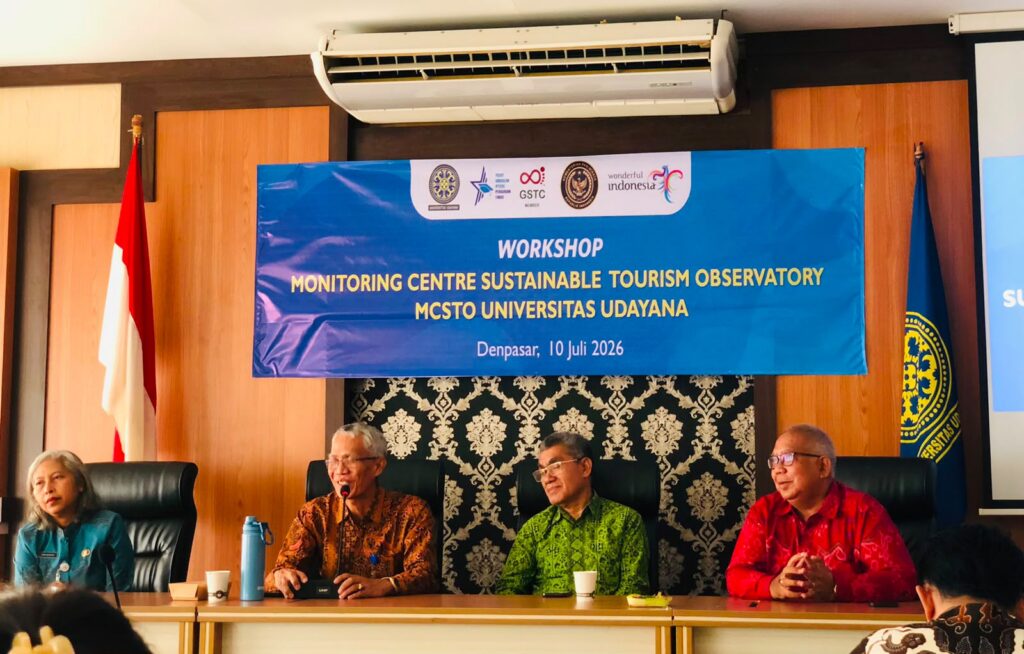
“Sustainable tourism is no longer just a concept. Its implementation must be measurable through clear indicators, so that the benefits are truly felt by the community, tourists, and the environment,” he emphasized.
Meanwhile, the Head of the Denpasar City Tourism Office highlighted the need for a rejuvenation strategy for the Sanur area. As a destination that has developed since the pioneering era of Balinese tourism, Sanur faces new challenges in the form of increasing traffic congestion, waste management, liquid waste, and development pressures due to investment growth. The Denpasar City Government has undertaken various development efforts, such as pedestrian development, underground utility arrangements, the implementation of low-emission zones through a Mayoral Regulation, and the development of area governance.
However, the success of physical development is deemed necessary to be balanced with strengthened regulations, oversight of tourism business legality, evaluation of the OSS-based licensing system, and improvements to the quality of destination services. In this context, the results of the MCSTO study are expected to provide a scientific basis for the development of various regional policies, including improvements to tourism regulations in Denpasar City.
The discussion session demonstrated that sustainability issues are not solely related to environmental aspects, but also encompass tourist safety, coastal area management, and the preservation of history and cultural identity. Dr. Agus Dharma, a member of the Udayana University MCSTO team, emphasized the importance of improving water tourism safety systems, particularly in the northern coastal areas of Sanur and Padanggalak, through the provision of safety facilities, emergency response systems, and cross-agency coordination.
Meanwhile, academic Prof. I Nyoman Darma Putra highlighted the need for destination development that maintains the historical character of Sanur. The development of a heritage-based tourism trail and the enhancement of visual arts are considered capable of enriching the tourist experience while strengthening the region’s identity. A historical narrative about the landing of the Komala Sari ship in 1906, which later became part of the series of events leading to Puputan Badung, was proposed for development as part of the destination’s historical interpretation. This approach is considered capable of enhancing the quality of the tourist experience through the delivery of educational and contextual historical stories.
Various workshop participants also emphasized the importance of policy integration between the Central Government, Regional Governments, Universities, the Tourism Industry, Traditional Villages, and the local community. Academically, this collaborative model reflects the application of the concept of collaborative governance, where the success of destination development is determined not solely by the government, but by the synergy of all stakeholders in the planning, implementation, and evaluation processes of policies.
The workshop also resulted in a commitment to extend the Memorandum of Understanding (MoU) between the institutions as a basis for strengthening the MCSTO institution while maintaining the sustainability of the tourism observatory in Bali. Through strengthening the observatory’s function, institutional revitalization, and cross-sector collaboration, Sanur is expected to become not only a Leading Tourism Destination in Indonesia but also an example of best practices in sustainable destination management at the international level. Thus, tourism sustainability is no longer viewed as a slogan, but rather as a measurable, inclusive management system that provides long-term benefits for the community, the environment, and the tourism industry.