
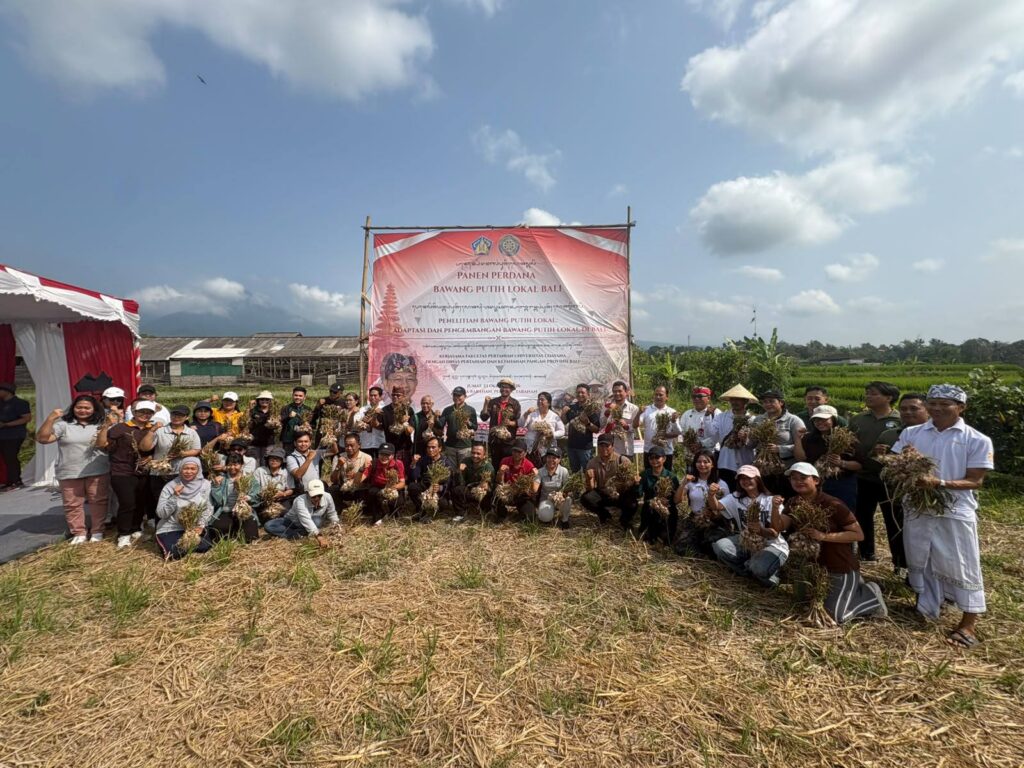
TABANAN — A collaboration between a research team from the Faculty of Agriculture at Udayana University, the Bali Provincial Agriculture and Food Security Agency, and local farmers resulted in the first harvest of indigenous garlic—specifically the ‘Kayu’ and ‘Cicih’ varieties—at Subak Aya, Babahan Village, Penebel District, Tabanan Regency, on Friday (October 23, 2026). The event, attended by approximately 150 people, serves as part of an effort to preserve local varieties while strengthening Bali’s food self-sufficiency.
The development of these indigenous garlic varieties relies on effective communication, coordination, and collaboration among all stakeholders, combined with consistent implementation and the application of local wisdom. Through this partnership, it is hoped that indigenous garlic will become a sustainable source of supply, helping to reduce reliance on imported garlic.
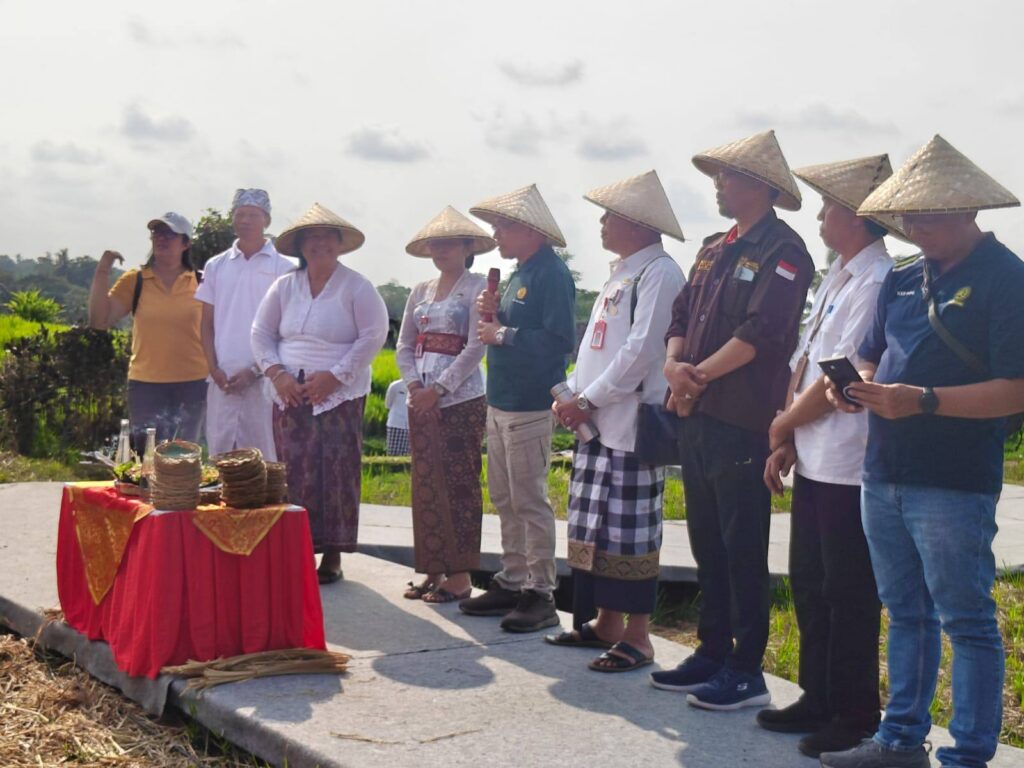
The event was attended by the Director of the Directorate of Research and Community Service at Udayana University, the Dean of the Faculty of Agriculture at Udayana University, the Head of the Center for Horticultural Agriculture Assembly and Modernization, the Head of the Vegetable Crop Assembly and Testing Center, the Head of the Bali Center for the Implementation of Agricultural Modernization, and the Dean of the Faculty of Agriculture at Udayana University. Also present were the Head of the Bali Provincial Agriculture and Food Security Agency, the Head of Penebel District, the Head of Babahan Village, the *Kelian* (head) of Subak Aya, and seven *kelian tempek* (sub-district/local irrigation unit heads).
The proceedings began with participant registration, followed by the inaugural harvest of the ‘Kayu’ and ‘Cicih’ garlic varieties. After the harvest, the event continued with remarks from the Head of the Bali Indigenous Garlic Research Team, Prof. Dr. Ir. Ni Luh Kartini, M.S., and the Dean of the Faculty of Agriculture at Udayana University, I Putu Sudiarta, S.P., M.Si., Ph.D. …along with the Head of the Bali Province Agriculture and Food Security Office, I Wayan Sunada.
In her statement, Prof. Kartini explained that ‘Kayu’ and ‘Cicih’ are local Balinese garlic varieties that have been cultivated since the 1970s. Their development is part of a strategic research program focused on the adaptation and advancement of local garlic, aimed at preserving local genetic resources while supporting both regional and national food security.
According to the Udayana University professor specializing in organic agriculture, the ‘Kayu’ variety excels in terms of quality, resilience, and its ability to adapt to altitudes of 450–550 meters above sea level. Officially released in 2022, this variety features a flat-round bulb with a hint of purple. Meanwhile, the ‘Cicih’ variety is currently undergoing further development to optimize its potential.
Prof. Kartini noted that the cultivation of the ‘Kayu’ variety in Subak Aya has yielded 8–10 tons per hectare at the time of harvest. This achievement highlights the potential of local garlic to serve as a commodity that supports the fulfillment of food needs in Bali.
She added that by 2026, the development of garlic in Bali will encompass seven hectares of land spread across the regencies of Tabanan and Buleleng.
“To achieve maximum results, farmers must be more creative and innovative in working their land. Local garlic is a pillar of our food security,” emphasized Prof. Kartini.
Beyond the selection of varieties, determining the optimal planting time and managing the land are also critical aspects of developing local garlic. Prof. Kartini explained that traditional Balinese wisdom—specifically the Balinese calendar—serves as a guide for scheduling planting. ‘Sasih Karo,’ the second month in the Balinese calendar, is considered the ideal time to begin planting the ‘Kayu’ and ‘Cicih’ varieties, while also taking into account rainfall conditions and water availability on the land. Regarding fertilization, he noted that garlic requires special attention due to its relatively shallow root system. Approximately 15 tons of organic fertilizer are needed for one hectare of land. The use of organic fertilizers and biological microorganisms—including mycorrhizae—is also integrated into cultivation management to support plant growth and nutrient uptake.
Following the welcoming remarks, the program continued with lunch, the presentation of mementos, a group photo, and the closing session. This inaugural harvest is expected to serve as a foundation for expanding the development of local Balinese garlic through ongoing collaboration between universities, the government, and farmers.